70% of patients never complete their home exercise programme.

Not because they gave up. Because they were left alone.

7 in 10
patient interviewees say adherence drop-off is triggered by routine disruption, not disengagement
"It's hard to maintain the motivation... you just get too busy, something else comes up."
PA01
9 in 10
patient interviewees reported uncertainty about if they were performing exercises correctly at home
"After you've been doing it for a while, you're not certain whether you're doing it correctly."
PA05
0–0 min
reported by physiotherapists as the time spent at the start of every appointment reconstructing what happened at home
"I spend 15–20 minutes going over what the patient did at home before moving forward with the recovery."
PT02

Two people. One shared journey.

Patient
Well Intentioned but Alone
They begin treatment with genuine intent. They start to drift off course, not because they lack motivation but because nothing is present in the between-appointment space to hold them on course when life gets in the way.
"It's hard to maintain the motivation… you just get too busy, something else comes up."
PA01

Patient
Patient
Well Intentioned but Alone
Phase 1
End of Session
"I walked out feeling like I knew exactly what to do."
PA04
Phase 2
First day at home
"After a while, you're not certain you're doing it correctly."
PA01
Phase 3
The drift
"I don't do it as much as she maybe hopes that I do."
PA03
Phase 4
Pre-appointment
"I don't want them to be disappointed."
PA10
Confident
Uncertain
Disengaged
Anxious
Physiotherapist
Clinician Working Blind
Between sessions, they have no mechanism to monitor what happens at home. Clinical decisions rest on self-report that both sides know is incomplete. The gap has been accepted as a structural feature of the job.
"I would love to eliminate the piece of paper with the hand drawing… it often gets crumpled or lost."
PT02

Physiotherapist
Physiotherapist Experience
Clinician Working Blind
Phase 1
End of Session
"I have a clear picture of where this patient is."
PT05
Phase 2
Between Sessions
"I hope they follow the programme. There's nothing I can do from here."
PT02
Phase 3
Pre-appointment
"I'll find out when they come in. Hopefully they've kept up with it."
PT03
Phase 4
Appointment
"The first 15, 20 minutes is catching up, that's time I'd rather spend on treatment."
PT01
Clear plan
No Signal
Preparing blind
Reconstructing
The most important part of recovery happens where physiotherapists have the least visibility.
Between every appointment, an entire week of experience goes untracked, unsupported, and unseen.

Business opportunity
70% adherence failure across physiotherapy patients worldwide. Clinical appointment time wasted on reconstruction. The clinical system that should exist between sessions does not, until now.
Introducing Movy
AI-generated exercise programmes. Intelligent schedule adaptation. Automated clinical synthesis. Movy makes the space between appointments work as hard as the appointment itself.
Made possible by agentic AI, a system that plans, acts, and adapts across weeks.
Patient is not alone.
Physiotherapist isn't blind.
Reconstruction eliminated.
Movy

Patient Interface

A proactive companion that acts on the patient's behalf between clinical sessions. Movy delivers their personalised exercise reference, adapts their schedule, checks in after every session, and keeps their physiotherapist informed.

Onboarding

Patient Onboarding

Before the first appointment, patient speaks to Movy. Patient speaks freely. Movy will ask follow up questions to collect data about the patient injury, schedule, lifestyle and goal. Movy listens and extracts a structured clinical profile from the conversation.

Agent extracts structured clinical data from natural language
Programme Generation

Programme Delivered

From two inputs, PT configuration and Patient onboarding, Movy generates a personalised AI-assembled reference video and exercise schedule simultaneously. Both arrive together on Sarah's home screen. She doesn't need to do anything.

Two inputs from two users synthesised into one coordinated output
Notifications

Session Notifications

The first notification arrives and patient begins their first session. Over the course of the cycle Movy monitors the weekly quota and sends the right type of prompt at the right moment. The schedule adapts silently to when she actually exercises.

Notification type selected autonomously, calibrated to quota, remaining days, and goal
Exercise Video

Program Exercise Session

Patient starts the session. They have a detailed reference to follow, giving them confidence and agency in the exercises. Movy delivers all exercise instructions in voice. Movy is present throughout the session. At the midpoint, Movy asks how it's going. Patient responds by voice.

Movy acts throughout the session without being prompted
Check-In

Post Session Check-in

After the session, Movy checks in. The opening question is shaped by what happened during the session. Patient responds naturally. Movy extracts adherence, pain, confidence, and difficulty from the conversation. If pain reaches the PT-configured threshold, a flag is raised in the pre-appointment summary.

Structured data extracted from natural language
Movy Adaptation

When the Programme Slips

The agent monitors, adapts, and informs. Movy detects quota gap, sends a calibrated message referencing patient own goal, and shifts the schedule. When the PT opens the pre-appointment review, the adherence gap is already there, flagged, reasoned, and documented.

The agent monitors, adapts, and informs
Patient Summary

Pre-appointment Review

Before the appointment, patient receives their own summary. They arrive knowing her physiotherapist already has the full picture. The pressure to self-report accurately under time pressure is removed.

Generated and delivered automatically, patient does not request it or compile it

Physiotherapist Interface

A clinical support tool that gives physiotherapists a standardised way to deliver a personalised programme, records what the patient does with it, and synthesises the full cycle into a structured clinical picture.

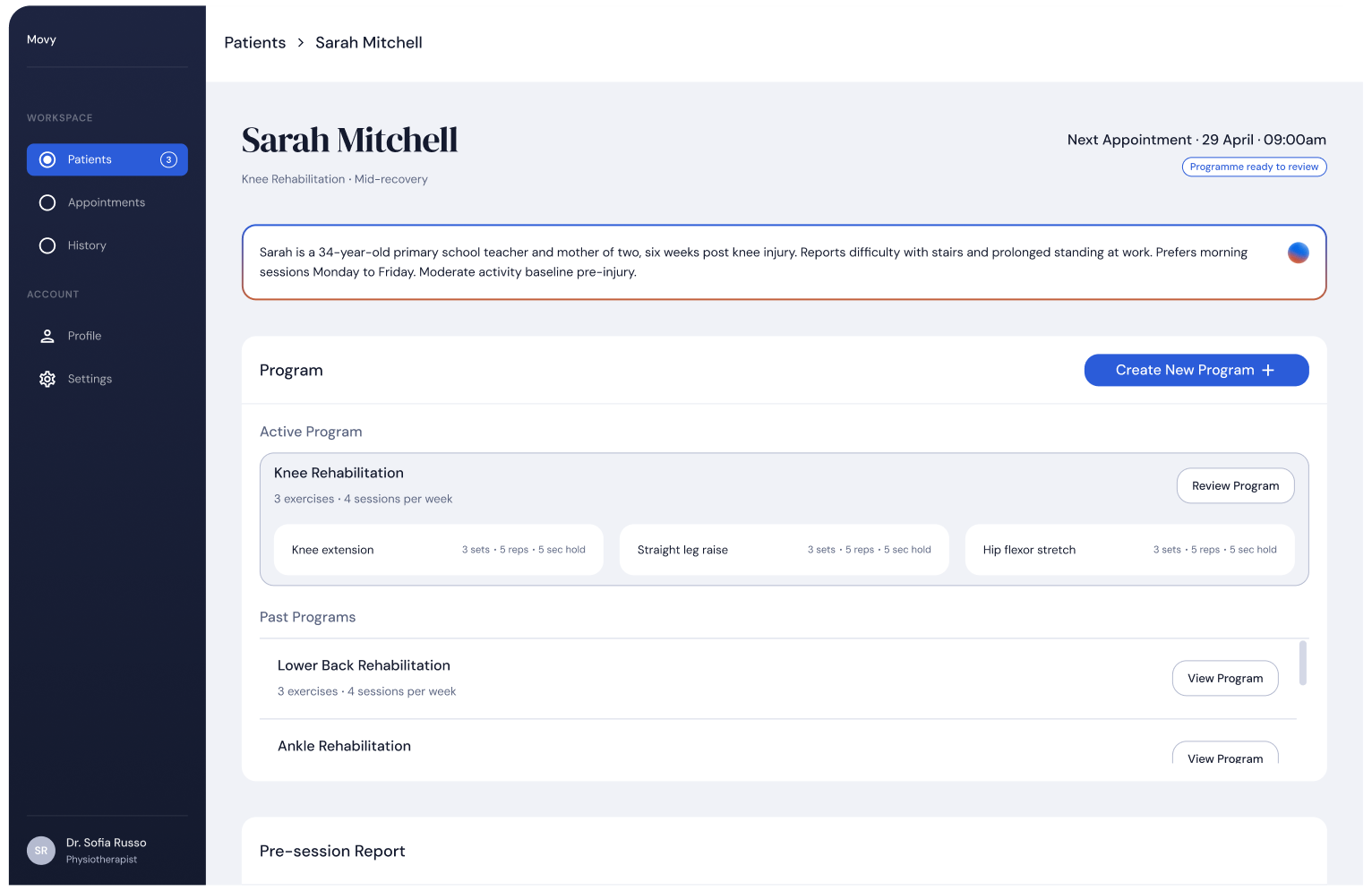
PT interface screen
Patient Profile

Patient Profile

Before the physiotherapist has configured anything, the patient profile is already there. The patient snapshot generated from the onboarding conversation. It tells the PT who the patient is, what they do, and what they want to get back to. Readable in under 30 seconds. The PT walks in knowing who they are treating.

No manual input from PT to create patient profile. Patient snapshot generated from onboarding.
Programme Configuration

Patient Program Configuration

PT selects exercises, sets parameters, and configures the pain threshold. On submission, Movy validates the inputs and generation begins. The PT's clinical judgement is the input. Everything that follows is automated by Movy.

Generation triggered autonomously on submission. PT approves before anything reaches the patient.
Pre-Appointment Review

Patient Pre-appointment Review

The summary arrives before the appointment. The PT gets a structured clinical picture with a generated synthesis. The reconstruction is eliminated.

Synthesised from the full cycle and delivered to both users simultaneously.

The Cycle

The five features are not independent tools. Each feeds the next. Movy acts across the full cycle.

1
Configure
PT inputs programme
→
2
Exercise
Patient exercises with Movy
→
3
Notify
Movy manages the week
→
4
Check in
Movy captures what happened
→
5
Summarise
Both sides receive the picture

See it in action

Talk to Movy